Are you confused about what is the difference between the RO, UV, UF, TDS Water Purifiers? Here you can know about the best water purifying technology and full form of the terms.
RO VS UV Water Purifier
Full Form
| Term | Full Form |
|---|---|
| RO | Reverse Osmosis |
| UV | Ultraviolet |
| UF | Ultra Filtration |
| TDS | Total dissolved solids |
Comparison Chart
This is the comparison chart table between the various technologies which are used for purifying the water for drinking.
| Difference | RO | UV | UF |
|---|---|---|---|
| Electricity | Required | Required | Not Needed |
| Method | Filter Bacteria & Virus | Kills Bacteria & Virus (Dead cells in water) | Filter Bacteria & Virus |
| Microbes Escape Possibility | Yes | No | Yes |
| Prefiltration | Need or Comes With Prefiltration | Need Prefiltration or Clear Water | No Need |
| Filtering Time | More Slower | Fastest | Slower |
| Dissolved Salts | Removed | Not Removed | Not Removed |
| Good Minerals | Removed | Not Removed | Removed |
| Toxic Materials | Removed | Not Removed | Removed |
| Water Taste | Not Natural | Natural | Not Natural |
| Muddy Water | Not Accepted | Not Accepted | Accepted |
| Water Wastage | More Water | No or Less Water | Less Water |
| Maintenance | Needed | Needed | Less Needed |
| Cost | Expensive | InExpensive | Average |
Nowadays most of the water purifiers use more than 1 technology to purify the water. So, the disadvantages gets eliminated. Check the list of best water purifiers and compare them.
Reverse Osmosis
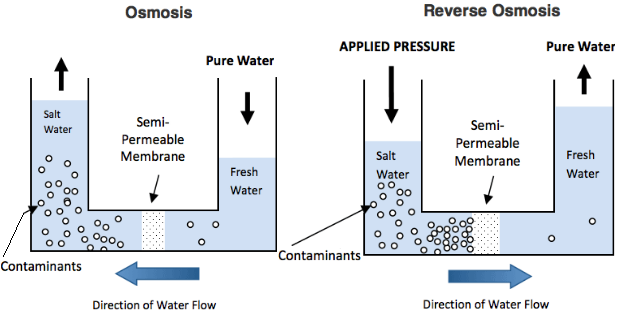
The full form of RO is Reverse Osmosis. The RO water purification uses a semipermeable membrane which filters the dirt present in the water by compressing the molecules. During the filtering process, the molecules are pressured to pass into the membrane which allows only the water molecules and stops the unwanted bigger substance from entering into the filtered drinkable water. The biggest drawback of the reverse osmosis purifier is the water wastage. Only 5 out of 15 percent of the water is purified by this process and the others will be released as wastewater. The RO purification not only removes the harmful substance but it will also remove the good minerals and irons in the water but some purifiers add some minerals for providing good taste.
Ultraviolet Water Purification
The full form of UV is the Ultraviolet. As the name indicates the ultraviolet water purification involves the UV-C light rays to kill the bacteria, virus, algae, molds, yeast which may present on the water. The ultraviolet rays are so powerful which will destroy the DNA of the bacteria and virus but it will not filters the water unless the purifier consists of additional filtering systems.
In some cases, the water purified with the UV technology may still consist of the microbes but their reproduction will be stopped and if such purified water kept directly under the sunlight then it may again convert all the bacteria into reproductive mode. Each UV water purifier uses a different dose level of UV and this is one of the effective water purification systems which will not introduce any chemical substance into the purified water. It is recommended that the water purified with the UV purifier must not be kept under the visible light for the significant amount of time. The UV bulb inside the purifier must be replaced per year and the UV bulb may still glove after a year but it will not give assurance that it still producing the UV rays.
Ultra Filtration
The term UF stands for the Ultra Filtration. It has a filter which removes the unwanted components and particles present in the water. The water is passed with some force against a hollow fiber threaded semipermeable membrane and this stops the bad elements from entering the water. The main advantage of UF water purifiers is that there is no need for the electricity to work.
Total dissolved solids
The water consists of many organic and non-organic particles such as the chloride, salt, iron, sulfur, ion, nitrate. These particles are being known as the Total dissolved solids (TDS). If it is mentioned that the water purifier will remove the TDS then these components will get removed from the water during the filtration process.
The US government has some regulation on the TDS present on the water. The TDS amount in the water has to be less and should not be more.
- TDS less than 300 is the best quality.
- TDS range from 300 to 600 is good quality.
- TDS range from 600 to 900 is average quality.
- TDS range from 900 to 1200 is of poor quality.
Note: Sometimes good minerals are added to the water which will increase the TDS amount but the water will not be harmful to drinking.